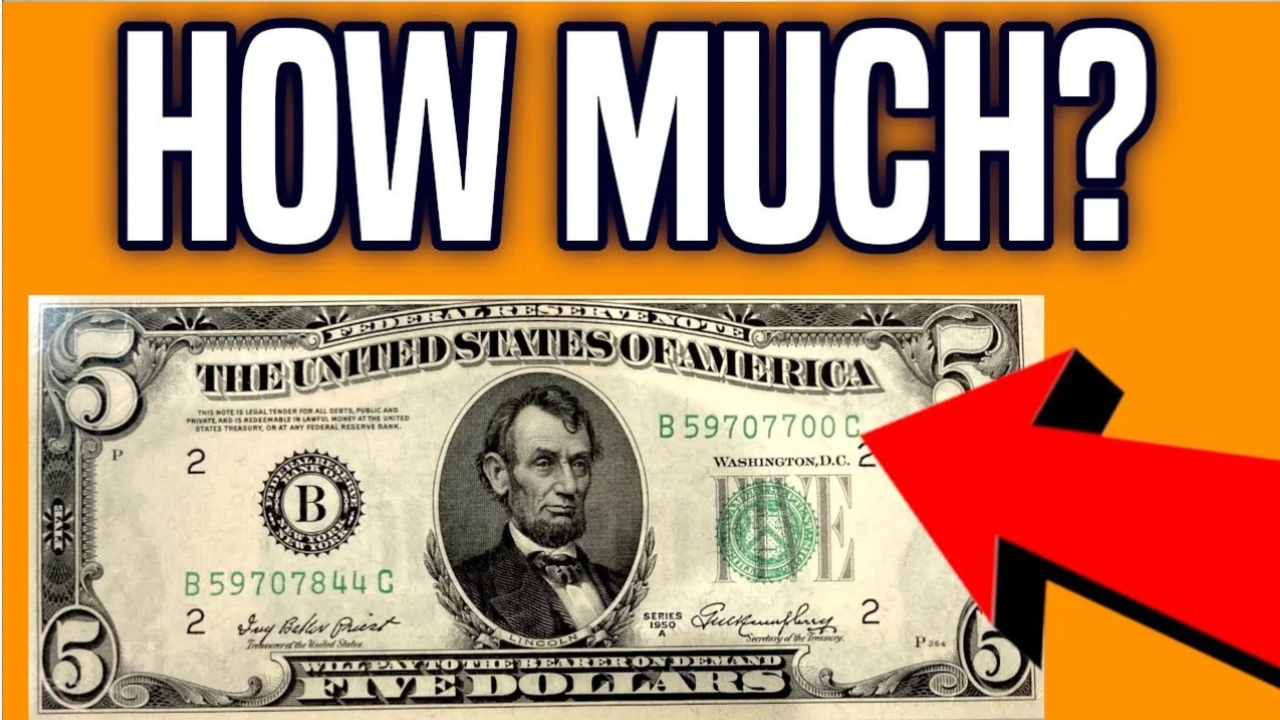
1995 $5 Bill:It’s easy to overlook the money you use every day—until a simple trip to the gas station, grocery store, or bank turns into a once-in-a-lifetime find. That’s exactly what’s been happening recently, as collectors and curious Americans across the country are learning about a rare 1995 $5 note stamped upside down—a small printing error that could make a big difference to the value of your wallet.
If you’ve ever wondered how to identify it, what it’s worth, and why it’s so rare, here’s your complete, human-friendly guide to identifying this interesting piece of American currency history.
The Story Behind the Upside-Down Stamp
The U.S. Bureau of Engraving and Printing (BEP) is responsible for printing the nation’s paper money, printing millions of notes every day. Despite the precision of their work, mistakes sometimes occur—and when they do, collectors call them “error notes.”
One of the most famous examples is a 1995 $5 Federal Reserve note with an inverted (upside-down) Treasury seal. This small but significant error occurred during the printing process when one of the final overlays—containing the green Treasury seal and serial numbers—was accidentally turned inside out before being pressed onto the note.
This mistake went undetected before a few copies were in circulation, allowing these misprinted notes to find their way into everyday wallets, bank deposits, and cash registers across the country.
Why is it So Rare?
Defective notes are already uncommon, but this one is especially popular because:
- Limited circulation: Only a small batch of 1995 $5 notes were struck before the printing issue was resolved.
- High destruction rate: Many notes were used, torn, or exchanged by banks before the error was discovered.
- Historical time: The mid-1990s were a transition period for American currency designs, making notes from that era even more interesting to collectors.
Today, genuine specimens with this reverse stamp error can sell for hundreds to thousands of dollars, depending on condition and rarity.
How to Identify the Upside-Down Seal
If you want to check whether you’ve got a rare bill, here’s exactly what to look for:
-
Start with the Date:
Look at the lower right corner of the bill’s face — the date should read “Series 1995.” That’s your first clue. -
Inspect the Green Seal:
Normally, the green Treasury seal appears upright to the right of Abraham Lincoln’s portrait. On the error bill, this seal is upside down, rotated roughly 180 degrees. -
Check the Serial Numbers:
The serial numbers are printed during the same process as the seal. On genuine upside-down seal notes, they remain correctly oriented — confirming that only the seal was flipped, not the entire design. -
Examine the Federal Reserve District Letter:
Most of the known errors came from Federal Reserve Bank districts A (Boston) and E (Richmond), but this can vary. -
Condition Counts:
The better shape your bill is in — crisp, clean, and without folds — the more valuable it can be. Collectors grade bills on a scale from “Good” to “Uncirculated,” with top-condition notes fetching premium prices.
What’s It Worth?
Values can vary dramatically based on rarity and condition:
-
Circulated bills: Typically worth between $100 and $500.
-
Uncirculated bills: Can bring $1,000 to $2,000 or more at auction.
-
Exceptionally rare examples: Some bills with pristine condition and verifiable serials have sold for over $3,000.
If you believe you have one, avoid spending or folding it. Instead, place it in a protective currency sleeve and consider getting it authenticated by a professional grading service, such as:
-
PCGS Currency (Paper Money Guaranty)
-
PMG (Paper Money Guaranty)
Authentication confirms whether your note is genuine and provides a grade that helps determine its market value.
Tips for Identifying Other Valuable Errors
When examining your notes, don’t stop at just $5 notes. Here are some other printing errors to look out for:
- Misaligned or off-center printing – when parts of the design are shifted too much in one direction.
- Missing seals or serial numbers – a common and valuable type of error.
- Double print or shadows – caused by printing twice by mistake.
- Reverse back designs – where the back of the note is printed upside down compared to the front.
Even minor flaws can make ordinary notes invaluable to collectors.
The Human Aspect of Hidden Value
The allure of finding a rare $5 bill isn’t just about the money itself—it’s about its story. Imagine discovering that something so ordinary that’s been passed from hand to hand for decades could be a hidden part of American history.
Collectors love these moments because they remind us that every dollar has a journey, and sometimes, even a small mistake can make it unforgettable.
So, the next time you take change from a store or withdraw money from an ATM, take a close look. That 1995 $5 note with the reverse seal might not be just pocket money—it could be a priceless piece of printing history waiting to be discovered.
FAQs
1. How can I tell if my $5 bill is an error note?
Look for the Series 1995 mark and an upside-down green Treasury seal. The serial numbers should remain upright.
2. How rare is this $5 bill?
Very rare — only a small batch made it into circulation before the error was caught.
3. How much can I sell it for?
Depending on condition, anywhere from $100 to over $3,000.
4. Where can I get it verified?
Use professional grading services like PMG or PCGS Currency.
5. Should I spend it or save it?
Definitely save it. Store it safely — you could be holding a valuable collector’s piece.
